
VITROHYPE.NET
The Age of Permanent Crisis. A World After September 11, 2001
Introduction: The Historical Rupture
September 11, 2001 did not simply mark a terrorist attack on the United States. It marked a historical rupture. From that moment onward, the world entered an era defined less by progress, stability, or collective imagination than by continuous crisis management.What followed was not a series of isolated emergencies, but a cascading transformation of global politics, economics, technology, and culture. The early twenty-first century became an age of permanent crisis a condition in which crises overlap, reinforce one another, and prevent long-term resolution.
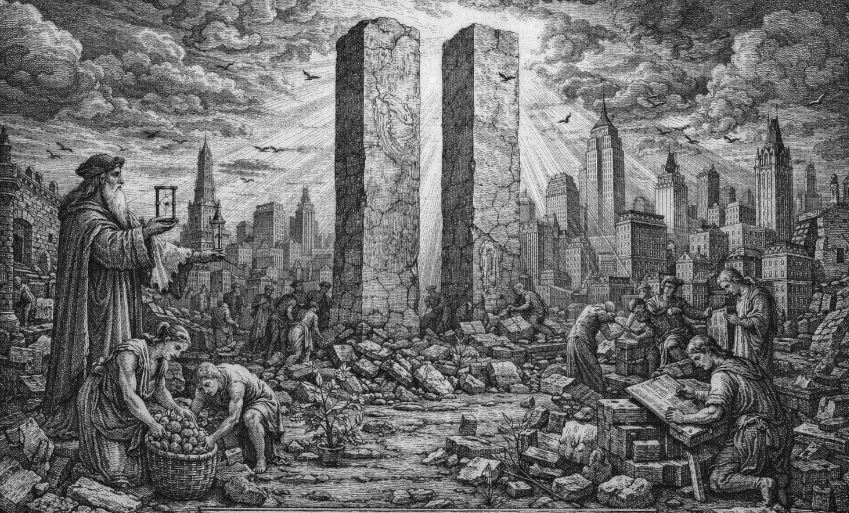
Phase I: The Security Shock and Permanent War (2001–2007)
The Post-9/11 Security Era
Trigger: Terrorist attacks on the United States (September 11, 2001)
Key developments:
Global War on Terror
Expansion of surveillance states and emergency security laws
Long-term erosion of civil liberties in democratic societies
Normalization of permanent military intervention
Major conflicts:
Afghanistan War (2001 - 2021)
Iraq War (2003 - 2011; instability continues)
Rise of transnational jihadist networks (Al-Qaeda, later ISIS)
Systemic impact:
Security became the dominant organizing principle of global politics. Emergency governance replaced long-term planning.
Phase II: Economic Collapse and Institutional Fragility (2007-2015)
Global Financial Crisis (2007-2009)
Trigger: Collapse of the U.S. subprime mortgage market
Consequences:
Global recession
Bank bailouts and financial consolidation
Austerity policies across Europe
Massive growth in wealth inequality
Deep loss of trust in financial systems
Eurozone Debt Crisis (2008 - 2015)
Affected states: Greece, Italy, Spain, Portugal
Outcomes:
Severe social unrest
Youth unemployment and brain drain
Political radicalization
Declining faith in democratic and European institutions
This period marked the collapse of the post–Cold War economic optimism and the beginning of widespread institutional distrust.
Phase III: Political Fragmentation and Middle East Collapse (2011 - 2019)
Middle East Destabilization
Collapse of Iraq after the 2003 invasion
Syrian Civil War (from 2011):
Over 500,000 dead
Massive refugee crisis
Rise and fall of ISIS Caliphate (2014 - 2019)
Repeated Israel / Palestine escalations, culminating later in Gaza (2023)
Systemic impact:
Regional instability, proxy wars, terrorism, and large-scale displacement reshaped global humanitarian and migration systems. Democratic Backsliding and Polarization
Rise of authoritarian populism (U.S., Hungary, Turkey, Brazil, India, others)
Attacks on:
Press freedom
Judicial independence
Electoral legitimacy
Normalization of disinformation and culture wars
A shared political reality began to fragment.
Phase IV: Great Power Conflict Returns (Present)
Russia - Western Confrontation
Georgia War (2008)
Crimea annexation (2014)
Full-scale invasion of Ukraine (2022)
Consequences:
End of the post Cold War security order
Energy crisis in Europe
Militarization of European states
Return of nuclear escalation risk
Rising Great Power Tensions
U.S. - China rivalry:
Trade and technology wars
Taiwan and South China Sea tensions
Militarization of the Indo-Pacific
The assumption of a stable, rules-based global order collapsed.
Phase V: Health, Economic, and Social Shock (2019 - 2024)
COVID-19 Pandemic
Impact:
Millions of deaths worldwide
Lockdowns and social isolation
Vaccine geopolitics
Mental health crisis
Long COVID
Structural changes:
Transformation of work and education
Expansion of state intervention
Explosion of public debt
COVID-Era Economic Shock
Supply chain collapse
Labor market disruption
Inflation surge
Cost-of-living pressures emerge
Global resilience proved weaker than expected.
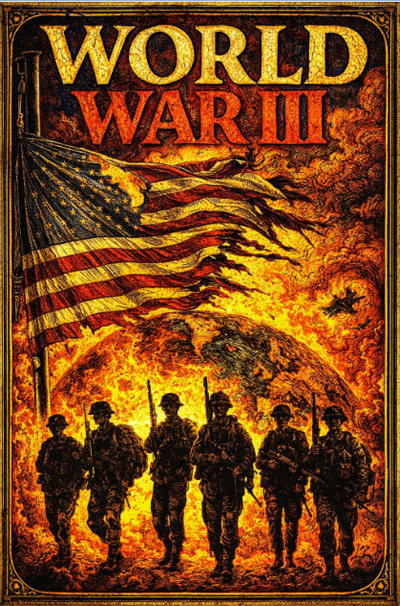
Phase VI: The Polycrisis Era (Present)
Cost-of-Living and Inflation Crisis
Rising energy and food prices
Housing crises
Growing precarity of middle classes
Heavy debt burdens on states and households
Environmental and Climate Crisis Acceleration
Extreme weather events
Rising sea levels
Food and water insecurity
Biodiversity collapse and pollution
Climate migration affecting millions
Climate change becomes a future conflict multiplier rather than a distant threat.
Technological and Information Crises (Ongoing)
Digital Surveillance State
Post-9/11 data collection regimes
AI-driven monitoring
Loss of privacy as a social norm
Social Media and Information Breakdown
Misinformation and radicalization
Algorithmic polarization
Election manipulation
Mental health damage from attention economies
Artificial Intelligence Disruption
Job displacement risks
Deepfakes and reality erosion
Autonomous weapons
Governance lagging far behind technological power
Cultural and Existential Crisis
What does the money machine eat?
It eats youth, spontaneity, life, beauty, and, above all, it eats creativity.
It eats quality and shits quantity.
William S. Burroughs
Crisis of meaning and purpose
Work without fulfillment
Algorithmic life optimization
Loss of autonomy and creativity
Collapse of the idea of progress itself
The Meta-Crisis: Permanent Emergency
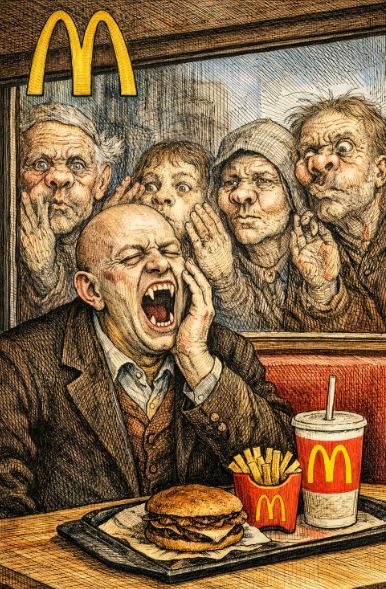
Since September 11, the world has entered a condition characterized by:
Continuous emergency governance
Overlapping and self-reinforcing crises
Loss of long-term vision
Fear replacing collective imagination
This condition is often described as a polycrisis a system in which crises interact, amplify each other, and prevent resolution. September 11 was not just a terrorist attack.
The War with Iran
© Vitrohype / Heyo Wurch
vitrohype.net Digital and Analogue Arts, Video, Programming,
Music and Graphics... Postadress / Imprint: Germany
Nienburgerstr. 56 - 31638 Stöckse ~ For donations
please use the German Post Giro IBAN DE42 3601 00430495 5544
35 Germany.