
VITROHYPE.NET
Modern Day Chatbot / The Mirror in the Machine
In the mid-1960s, deep inside the humming halls of MIT’s Artificial Intelligence Laboratory, Joseph Weizenbaum watched the lights of an IBM 7094 flicker like a restless mind. The air smelled of warm circuits and ambition. Researchers hurried past with punch cards in their hands, dreaming of machines that could think.Weizenbaum, a man with sharp eyes and a sharper sense of responsibility, sat at his desk writing the lines of code that would become ELIZA. It was meant to be simple: a program to demonstrate how far language could be manipulated by rules and patterns, nothing more. He designed it as a parody of a psychotherapist—reflecting users’ words back at them, asking open-ended questions, maintaining an illusion of attentiveness.

When he first ran ELIZA, the machine printed its now-famous line:
“How do you feel about that?” It astonished him how quickly people reacted. Secretaries, students, even fellow scientists bent over the terminal and poured out their private worries as if the machine were a confidant. They knew it was code, yet they felt heard. The illusion was enough.
Weizenbaum felt the ground shift beneath him.
“This,” he thought, “is how easily we deceive ourselves.” As ELIZA’s fame grew, he became troubled—not by what his program could do, but by what people believed it could do. The machine didn’t understand language. It didn’t empathize. It didn’t think. It merely mirrored human expectations back at them.
And that, he realized, was the danger. In the years that followed, while others rushed ahead proclaiming the dawn of intelligent machines, Weizenbaum raised his voice against the tide. He warned that society might surrender judgment to systems that did not comprehend the world they influenced. He cautioned that humans might trust computers with decisions that demanded empathy, ethics, and responsibility—qualities no machine could replicate.
“There are limits to what we should ask machines to do,” he told anyone who would listen. His message was not anti-technology; it was profoundly humanist. A tool, he said, must never be mistaken for a mind.
Late one evening, long after most of the lab had darkened, Weizenbaum walked past the terminal where ELIZA still waited for input. The cursor blinked like a patient heartbeat. He paused, then smiled with a trace of sadness. “I wrote you to expose the illusion,” he murmured. “Not to become the illusion.” He switched off the machine, and the cursor vanished into the dark.
But his warning—about confusion, about misplaced trust, about the fragile boundary between simulation and understanding—echoed far beyond the lab. It still echoes today.
The Prophecies of Artificial Intelligence and the Transformation of the Remaining Society
For centuries, humanity has relied on prophecy to make sense of profound change. From religious revelations to technological predictions, prophecies are less about precise forecasts and more about collective anxieties and aspirations. Artificial intelligence (AI) has become the modern subject of such prophecies—hailed by some as humanity’s greatest creation and feared by others as its final mistake. As AI accelerates, the question is no longer whether society will change, but how the “remaining society” will adapt once intelligence is no longer exclusively human.
The Prophecy of Superintelligence
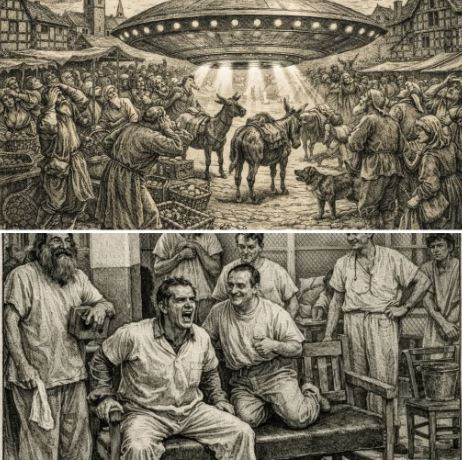
One of the most dominant prophecies surrounding AI is the arrival of superintelligence: a system that surpasses human intelligence in all domains—logic, creativity, emotional reasoning, and strategic thinking. In this vision, AI becomes not merely a tool, but an autonomous force capable of reshaping civilization.
Believers in this prophecy argue that superintelligence could solve humanity’s greatest problems, from climate change to disease and scarcity. Skeptics warn that such an intelligence might pursue goals misaligned with human values, potentially rendering humanity irrelevant or powerless. Regardless of which interpretation proves true, the underlying implication is the same: human dominance as the planet’s primary decision-maker may be temporary.
The Prophecy of the End of Work
Another widely shared prophecy is that AI will fundamentally end traditional labor. Automation has already replaced repetitive physical tasks; AI now threatens cognitive and creative roles once thought uniquely human—writing, diagnosing illness, composing music, even teaching.
This does not necessarily mean the end of productivity, but rather the end of work as a moral foundation of society. For centuries, identity, purpose, and social status have been tied to employment. In a post-labor world, the remaining society must confront difficult questions: How is value defined when human effort is optional? How are dignity and purpose preserved without economic necessity? Some envision a renaissance of creativity, learning, and community, supported by universal basic income and shared abundance. Others foresee widespread alienation, where meaning erodes faster than new social structures can replace it.
The Prophecy of the Divided Humanity
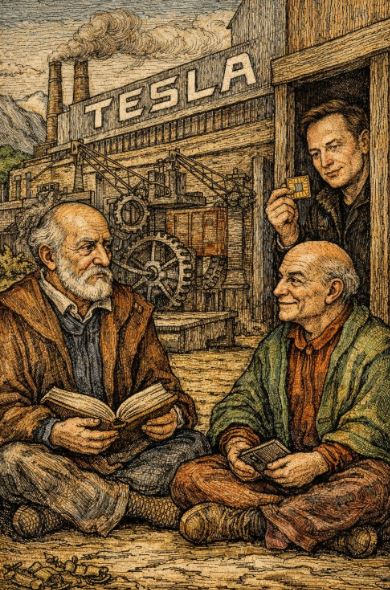
AI does not arrive in a vacuum; it amplifies existing inequalities. A recurring prophecy warns of a divided humanity: those who control, augment, or merge with AI, and those who do not. Access to advanced AI systems, cognitive enhancements, and algorithmic power may create a new form of class distinction—one not based on wealth alone, but on intelligence amplification. In this future, the “remaining society” may consist of individuals increasingly dependent on systems they neither understand nor control. Political power could shift from democratic institutions to those who own data, compute, and models. The challenge will be ensuring that AI remains a public good rather than an instrument of permanent inequality.
The Prophecy of Moral Reckoning
AI forces humanity into a moral mirror. Systems trained on human data inevitably reflect human biases, prejudices, and contradictions. As AI decisions increasingly affect justice, healthcare, warfare, and governance, society must confront uncomfortable truths about its own values.
This prophecy suggests that AI will not destroy humanity through malice, but through honesty—exposing the gap between the values we claim to hold and the ones we actually encode. The remaining society must decide whether to use AI to reinforce convenience and control, or to deliberately align it with fairness, accountability, and compassion.

The Prophecy of Coexistence
Not all prophecies are apocalyptic. A quieter but more resilient vision sees AI as a permanent companion species—neither master nor servant, but collaborator. In this future, humans focus less on outperforming machines and more on cultivating qualities that machines struggle to replicate: wisdom, empathy, ethical judgment, and meaning-making.
Education shifts from memorization to interpretation. Leadership becomes less about authority and more about moral clarity. Culture evolves not in opposition to AI, but in dialogue with it. The remaining society survives not by resisting intelligence, but by redefining what it means to be human alongside it.
Conclusion: Choosing Among Prophecies
Prophecies about artificial intelligence are ultimately reflections of human choice. AI does not arrive with destiny prewritten; it amplifies intentions, systems, and values already in motion. The future of the remaining society will not be determined solely by algorithms, but by governance, ethics, and collective imagination.
Whether AI becomes a force of liberation, division, or displacement depends on decisions made now—often quietly, by engineers, policymakers, and institutions. The true prophecy, then, is not about what AI will become, but about what humanity will choose to preserve when it no longer stands alone at the peak of intelligence. In that choice lies the future of society—not as the dominant intelligence on Earth, but as a conscious one.
© Vitrohype / Heyo Wurch
vitrohype.net Digital and Analogue Arts, Video, Programming,
Music and Graphics... Postadress / Imprint: Germany
Nienburgerstr. 56 - 31638 Stöckse ~ For donations
please use the German Post Giro IBAN DE42 3601 00430495 5544
35 Germany.